
EXCUSE ME. WHERE’S MY WHITE HOUSE PRESS PASS? 😂
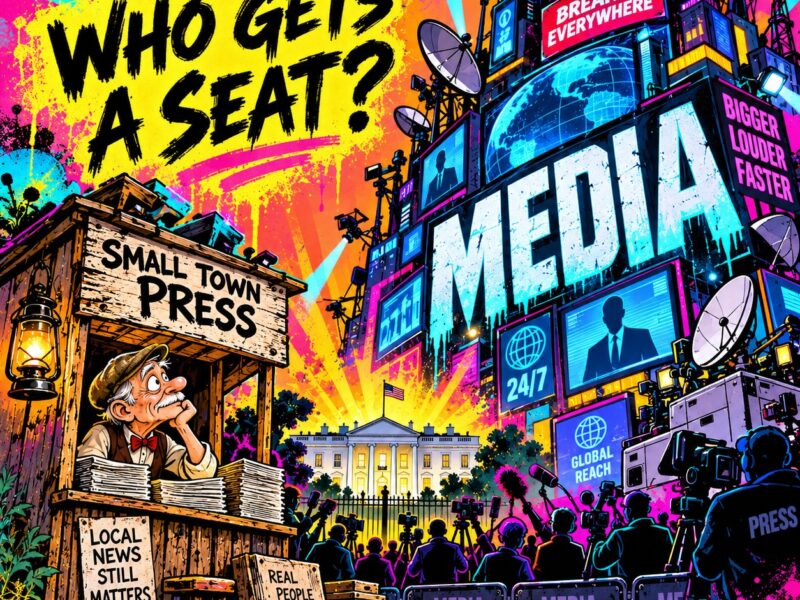
CNN, MS NOW and Politico are fighting to get back into the White House. That got me wondering who exactly gets to call themselves “the press” in 2026.
📰 I READ THIS STORY AND HAD A PRETTY SIMPLE QUESTION.
President Trump barred CNN, MS NOW and Politico from White House grounds. The three news organizations sued, arguing that their access was revoked in retaliation for coverage the administration disliked and that the action violated First Amendment and due-process protections. The White House argues that physical access to the White House is a privilege, not an unrestricted constitutional right. A federal judge is being asked to sort it out.
Naturally, the whole thing immediately became another political fight.
Free press. First Amendment. Government retaliation. Media bias. Trump. CNN. The people’s White House.
You know the routine.
But I read the story and started laughing for a completely different reason.
I own Freak Sites, Inc. I operate eight niche media websites. I publish commentary. I write about current events. I can write about the President, interview somebody, publish photographs and video and distribute all of it online.
So…
EXCUSE ME. WHERE’S MY WHITE HOUSE PRESS PASS? 😂
⭐ I’M SERIOUS. WELL… SORT OF.
If the argument were simply, “We publish news, therefore we have a constitutional right to walk into the White House,” I might need to start packing.
I’ll grab a notebook. Charge my phone. Find something respectable to wear.
Maybe The Writers Freak can come along. The White House even launched something called Trump TV this week, so apparently everybody is experimenting with what a modern media operation looks like. The White House describes it as “Trump TV: The Essentials Station,” while outside coverage describes it as a 24/7 streaming operation built around presidential content.
My crazy green Writers Freak has three arms, which means he can carry a camera, microphone and notebook at the same time.
A very efficient journalist. 😂
But that isn’t actually the legal argument CNN, MS NOW and Politico are making.
Their argument is narrower: they already had access, and they say the administration removed it because it objected to their reporting. The administration disputes that characterization and says access can be restricted.
Apparently that distinction matters.
And legally, it does.
🏛️ FREEDOM OF THE PRESS DOESN’T COME WITH A RESERVED CHAIR.
So I pulled up my AI chair, invited my three-armed AI character to sit with me and started digging.
One of the important cases goes all the way back to 1977.
In Sherrill v. Knight, Washington correspondent Robert Sherrill had been denied a White House press pass. The federal appeals court held that First and Fifth Amendment interests were implicated and that denial required procedural protections including notice, an opportunity to respond and a written decision.
But the same court also said the general public does not have a general constitutional right to enter the White House. Nor does the fact that a President speaks with some journalists mean every journalist automatically receives the same access. Once the White House voluntarily creates press facilities for bona fide Washington journalists, however, access cannot be denied arbitrarily.
So I can publish something about the President this afternoon. CNN can. Somebody with a Substack can. A guy sitting at his kitchen table recording a podcast can.
A woman sitting on her porch in Arkansas can write an essay criticizing the President and publish it online before dinner.
The freedom to publish and the right to physically enter a government facility are not the same thing.
Fine.
But now we get to the part that interests me.
WHO EXACTLY IS “THE PRESS” NOW?
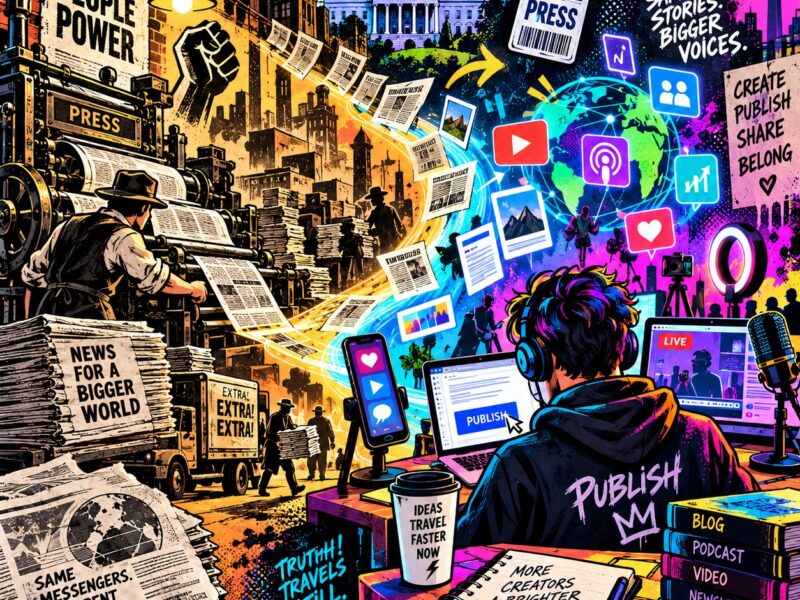
This was probably easier to picture in 1849.
You had a newspaper. You had a printing press. Somebody bought ink by the barrel. People folded sheets of paper and somebody stood outside yelling:
NEWS! READ ALL ABOUT IT!
Pretty obvious. 😂
Even by 1950, the media world was fairly easy to recognize. Newspapers, magazines, radio, wire services and television were the machinery that distributed information to large audiences.
There were publishers. There were broadcasters. And then there was everybody consuming what those institutions produced.
The press and the audience were relatively easy to tell apart.
Today?
Yeah, good luck.
📱 TODAY I CAN BECOME A PUBLISHER BEFORE LUNCH.
Anybody with the tools and something to say can create a website, newsletter, podcast, YouTube channel, livestream, Substack, local publication or an entire network of niche media websites.
You can cover city hall from your kitchen. Interview a presidential candidate on a podcast. Publish original reporting without owning a printing press. Reach millions of people without owning a television tower.
The machinery that once separated a giant media company from almost everybody else has changed dramatically.
PUBLISHING BECAME SOFTWARE.
That changed what a publisher can look like.
What it did not erase was everything established institutions had already accumulated: brands, money, employees, lawyers, distribution, relationships, decades of recognition and—here’s the big one—
access.
👑 RULING CLASS AND PEASANTS?
Okay, legally, America does not have one constitutional class called “the ruling class” and another called “the peasants.”
I know that. 😂
I’m being sarcastic.
But stand far enough away from the legal language and look at the practical arrangement.
Mom sitting on her porch in Arkansas has First Amendment rights. I have First Amendment rights. Corporate speakers can also receive substantial First Amendment protection under current law. CNN and Politico can invoke those protections too.
But Mom isn’t walking into the White House briefing room tomorrow.
Neither am I.
CNN already had credentials. Politico already had credentials. MS NOW already had credentials.
And when that established access disappeared, these enormous media organizations had the attorneys and resources to walk directly into federal court and challenge the President of the United States.
Legally, there are reasons those situations are different.
Practically?
We are obviously not all standing in the same line.
That’s the irony.
🏢 AND THEN THERE’S THE CORPORATION PROBLEM.
This is where I know the lawyers can have a field day.
Under current Supreme Court doctrine, political speech does not lose First Amendment protection merely because the speaker uses the corporate form. Citizens United is one prominent modern example. That does not mean corporations possess every constitutional right that a flesh-and-blood human possesses.
Fine.
That’s what the law says today.
But that isn’t the same thing as saying this entire legal arrangement dropped fully formed out of the Constitution in 1791.
The Bill of Rights was ratified on December 15, 1791, and the First Amendment protects freedom of speech and of the press.
I’m reasonably confident James Madison wasn’t sitting around asking:
“OKAY, BUT WHAT HAPPENS WHEN A $111 BILLION MEDIA CONGLOMERATE NEEDS WHITE HOUSE CREDENTIALS?”
😂
That world didn’t exist.
Courts eventually had to decide how constitutional language written centuries ago applies to corporations, technologies and institutions that developed later.
That is what courts do.
But I think we’re still allowed to notice the difference between:
“THIS IS CURRENT CONSTITUTIONAL LAW.”
and
“THIS IS EXACTLY WHAT EVERYBODY IN 1791 HAD IN MIND.”
Those are not automatically the same statement.
🤔 ACTUALLY, THE SUPREME COURT HAS ARGUED ABOUT THIS TOO.
The disagreement isn’t something I invented while sitting around building Writers Freak.
In Citizens United, the majority held that government generally cannot suppress political speech merely because its source is corporate. Justice John Paul Stevens disagreed with important parts of that approach in dissent and challenged the idea that corporations should simply be treated as members of the political community in the same sense as human citizens.
That was a dissent.
It isn’t the controlling rule.
But apparently even Supreme Court justices can look at this question and essentially ask:
“Wait a minute. What exactly is this thing?” 😂
And long before CNN existed, Chief Justice John Marshall famously described a corporation in 1819 as:
“an artificial being, invisible, intangible”
existing through law.
Exactly.
Artificial.
Created by law.
🤖 WHICH MAKES ME WONDER ABOUT AI.
Now this gets really weird.
Stay with me.
A corporation isn’t a human being. It doesn’t eat breakfast, have children or sit on a porch in Arkansas.
It is a legal structure human beings create so they can organize property, contracts, ownership, liability and business activity under one entity.
I have one.
Freak Sites, Inc.
Very useful.
But Freak Sites, Inc. doesn’t wake up in the morning.
I do.
Now look at AI.
AI isn’t Mom sitting on the porch either.
Yet I can use AI to research, edit, create images, analyze information, generate narration and argue with me for twenty minutes about whether something I wrote has finally gone too far.
😂
So let me ask a ridiculous question:
WHAT HAPPENS WHEN SOMEBODY EVENTUALLY ARGUES THAT AI HAS FREE-SPEECH RIGHTS?
Maybe the argument comes from OpenAI.
Maybe Elon Musk makes it about one of his systems.
Maybe Google does.
Maybe some company that doesn’t exist yet does.
Maybe nobody ever succeeds.
I have no idea.
That’s why it’s a hypothetical.
But imagine a future lawyer arguing:
Our AI generated political speech. The government suppressed it. The First Amendment protects the expression regardless of whether its source is biological.
Now what?
Whose right are we talking about?
The AI? The company that owns it? The person who prompted it? The people who want to read what it produced?
Suddenly our weird little corporation discussion doesn’t seem quite so historical anymore.
The legal system is already wrestling with a related human-versus-machine question in copyright. The U.S. Copyright Office says AI-assisted work can receive copyright protection when there is sufficient human authorship, while merely prompting an AI does not by itself make purely AI-generated expression copyrightable.
So we’re already asking:
Where does the machine end and the human begin?
😂 AND THEN COMES CAPTAIN HOOK.
Suppose fifty years from now a court creates some legal doctrine protecting autonomous AI expression.
Fine.
Maybe that becomes law.
People in 2076 might grow up thinking it’s completely normal.
But that still wouldn’t mean somebody pulled out the First Amendment in 1791 and said:
“MAKE SURE THIS COVERS CHATGPT.”
It didn’t exist.
Neither did CNN, television, the Internet or Freak Sites.
Neither did Captain Hook. 😂
If a court someday decides an artificial intelligence has some kind of constitutional speech protection, that may become the law.
It still doesn’t mean James Madison wrote the First Amendment with Captain Hook in mind. 😂
That distinction matters to me.
😂 WHICH BRINGS ME BACK TO CNN.
Sometimes the rhetoric surrounding a press fight can make it sound as though four people working at a small-town newspaper are being thrown off the courthouse steps because the mayor didn’t like Tuesday’s editorial.
That is not what modern mass media looks like.
CNN is part of Warner Bros. Discovery, which Paramount Skydance is moving toward acquiring. The transaction has been widely described at roughly $110 billion enterprise value, while current reporting also describes it as about $111 billion including debt. Paramount recently settled lawsuits brought by 12 states and the Writers Guild of America, clearing a major hurdle, and CEO David Ellison told employees the company hoped to close the transaction in roughly two weeks.
Let me write the newer number out because numbers start looking fake once they get big enough:
$111,000,000,000.
What’s another billion when you’re buying one of the biggest media combinations on Earth? 😂
The transaction would put major entertainment, film, television, streaming and news properties—including CNN and CBS News—inside the combined company.
Does CNN’s size eliminate constitutional protections implicated when its journalists lose access?
No.
But let’s at least be honest about the institution we’re discussing.
THIS IS NOT THE LOCAL NEWSPAPER IN 1849.
This is modern corporate mass media.
😂 WAIT. THIS GETS EVEN WEIRDER.
While I’m sitting here asking why Freak Sites doesn’t get a White House press credential, the combined corporation would become one of the largest media businesses on Earth.
And here’s something that changed while I was writing this very Parking Spot.
Paramount originally described the transaction at roughly $110 billion. Current reporting is also describing it as a $111 billion transaction including debt.
So I updated the number.
That’s something you can do with a Parking Spot here at Writers Freak.
What you write here isn’t locked in stone.
If new information changes the story, you can update your Parking Spot without adding more coins to the meter. 😂
And then I found another detail.
Three Middle Eastern sovereign investment funds are expected to have substantial non-voting economic stakes in the combined company. According to Paramount’s FCC disclosures, the expected stakes include Saudi Arabia at about 15.1%, the United Arab Emirates at 12.8% and Qatar at 10.6%—about 38.5% combined.
The arrangement does not give those funds voting control. The FCC approval restricts foreign investors from voting stock and from participating in management or content decisions, while the Ellison family and RedBird retain voting control.
A few American billionaires.
Fine.
But just stand back and look at what we’ve built.
A giant American media corporation containing CNN and CBS News can have billions of dollars of economic ownership supplied by foreign sovereign wealth funds while news organizations inside this modern media ecosystem invoke the United States Constitution in court over access to the American President.
And somehow the guy operating eight American media websites is still waiting by the mailbox for his press badge.
😂
I’m not saying those are legally equivalent situations.
I’m saying that if you can look at that arrangement without asking questions about corporations, foreign capital, media power, money, access and what we now mean by “the press,” you have considerably more self-control than I do.
Maybe that’s because I’ve spent much of my life in sales.
Sales teaches you to listen for framing.
Who defined the problem? Who chose the words? What objection is being answered? What information is being emphasized? What information isn’t?
Politics does it. Advertising does it. Mass media does it. President Trump does it. His critics do it.
EVERYBODY IS TRYING TO FRAME THE STORY BEFORE SOMEBODY ELSE FRAMES IT FOR THEM.
And when enormous institutions are fighting over access to the President while simultaneously fighting over how millions of people will understand what the President said, I think the business of narrative belongs in the conversation too.
📺 MS NOW ISN’T PRINTING FLYERS IN SOMEBODY’S GARAGE EITHER.
MS NOW, formerly MSNBC, is part of Versant, which became an independent public company after its spin-off from Comcast in January 2026. Versant reported approximately $6.69 billion in revenue for 2025 and owns media brands including MS NOW, CNBC, USA Network, Golf Channel, E!, SYFY, Fandango and Rotten Tomatoes.
Politico is owned by German media company Axel Springer, which completed its acquisition in 2021 and became the 100% owner of Politico and several related properties.
And this is where my transatlantic joke came from.
No, I do not believe moving Freak Sites to Germany would magically give me extra First Amendment rights.
😂
The point is the irony.
A modern American publication can sit inside the corporate structure of a major transatlantic media company and participate in litigation asserting American constitutional protections concerning White House access.
Meanwhile, I can operate an American corporation, run multiple American media websites and publish about the exact same American President…
…and I’m still pretty sure nobody is saving me a chair.
Those aren’t legally identical situations.
That’s the point.
The freedom to publish and membership in the established press institution have become two very different things.
💰 ACCESS HAS BUSINESS VALUE TOO.
This may be the part people miss when the discussion immediately becomes political.
A White House reporter isn’t there simply because the chair is comfortable.
Access creates content.
The reporter asks the question. The camera captures the answer. The network broadcasts the clip. The website publishes the story. Social media spreads it. Other outlets respond. Audiences react.
That creates attention.
And attention has economic value.
Modern news organizations perform journalistic functions, but they are also businesses competing for viewers, readers, subscribers, advertising, distribution, interviews, video, breaking news and attention.
Lose access and you can lose material your competitors are using to attract the same audience.
That does not make their constitutional argument illegitimate.
It means something else can be true at the same time:
THERE IS A BUSINESS UNDERNEATH THE CONSTITUTIONAL PRINCIPLE.
If you miss that, I think you’re missing part of the story.
📰 AND THEY’RE COMPETING TO EXPLAIN WHAT THE STORY MEANS.
This is where everybody starts using the word “narrative.”
One side says journalists are gathering facts and making ordinary editorial judgments about what matters.
Another side accuses those same organizations of selecting facts and framing stories in ways that push a preferred narrative.
Those disagreements are nothing new.
What changed is scale.
One event happens in Washington and a giant television or digital organization can distribute its reporting about that event to millions of people almost instantly.
The President can bypass those organizations and distribute his own version through Truth Social, official White House channels and now Trump TV.
Independent publishers can publish their own interpretation.
Podcasters can talk about it for three hours.
YouTubers can cut the footage apart frame by frame.
People on X can argue about it until everybody involved forgets what the original story was.
😂
And they’re all competing for the same thing:
YOUR ATTENTION.
That is a very different media system from somebody buying tomorrow morning’s newspaper.
🎙️ SO WHAT HAPPENS WHEN EVERYBODY CAN BE MEDIA?
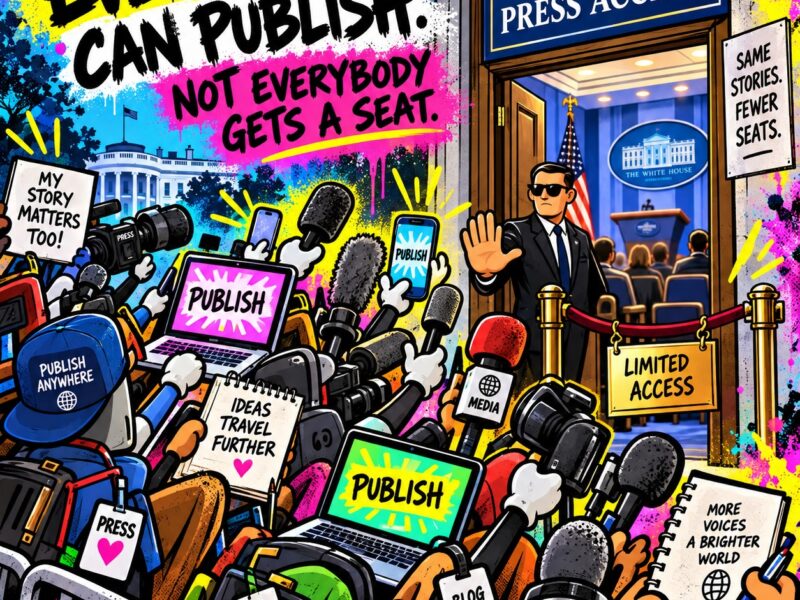
Imagine a room with a limited number of seats and thousands of people who can legitimately publish.
Who gets in?
Does it depend on audience size? Original reporting? Number of employees? Years in business? Reputation? Revenue? A Washington bureau? Membership in a press organization?
Or simply whether somebody in authority recognizes you as legitimate?
What about a podcaster with ten million listeners? A YouTuber with five million subscribers? A local newspaper with 8,000 readers? An independent investigative reporter? A photographer? A blogger? A one-person newsletter?
Or a company operating eight niche media websites?
WHERE EXACTLY DOES “THE PRESS” BEGIN AND END?
And who gets to decide?
That question is going to get harder.
Not easier.
✍️ THE FIRST AMENDMENT DOESN’T HAVE A BRAND LIST.
It doesn’t say CNN.
It doesn’t say Fox.
It doesn’t say NBC.
It doesn’t say The New York Times.
And unfortunately for my travel plans…
it doesn’t say Freak Sites either. 😂
The actual First Amendment prohibits Congress from abridging freedom of speech or of the press.
The current CNN/MS NOW/Politico dispute isn’t about whether those organizations remain free to criticize President Trump. They plainly continue reporting on him—including while barred from the White House.
Their lawsuit is about their exclusion from White House access and their allegation that the exclusion was retaliation based on their reporting. The administration argues access is a privilege and is defending the restrictions in court.
That’s a much narrower question than:
“DOES THE PRESS HAVE FREEDOM?”
😂 I’M STILL WAITING FOR MY BADGE.
I checked the mail.
Nothing. No invitation. No reserved chair. No Secret Service credential.
Not even a little placard saying:
THE SALES FREAK — FREAK SITES
Frankly, I’m not disappointed. 😂
The hypothetical is ridiculous.
That’s why I like it.
It demonstrates the point.
The fact that I operate media websites and publish commentary does not mean the White House has to move somebody out of a chair and let me sit down.
Likewise, the fact that CNN is connected to a massive corporation doesn’t erase the constitutional questions raised when its reporters lose established access.
And here’s where I think the distinction becomes important:
CNN IS A CORPORATION.
A CNN REPORTER IS A HUMAN BEING.
Same with MS NOW.
Same with Politico.
Those individual journalists are doing jobs. They’re gathering information, asking questions and publishing what they learn.
Whatever I think about the corporate structures above them, I don’t want to confuse the reporter with the corporation.
Both things can be true.
I can question the extraordinary institutional power of gigantic media corporations while still recognizing that individual journalists have speech and press interests of their own.
That makes the story more complicated.
Good.
Interesting stories usually are.
⭐ THE BIGGER STORY MAY BE WHAT HAPPENED TO “THE MEDIA.”
For generations, mass communication was expensive.
You needed presses, studios, towers, newsrooms, distribution systems, bureaus, employees and enormous amounts of money.
That naturally created a relatively small number of institutions capable of talking to huge audiences.
Today I can publish this Parking Spot from my computer.
I can add research, photographs, video and links. I can update it. Search engines can find it. Social media can distribute it. Somebody can send the link across the country in seconds.
And if you want to publish something here at Writers Freak too?
Seven dollars. 😂
The cost of becoming a publisher collapsed.
That doesn’t make Freak Sites CNN.
Let’s not get carried away.
CNN operates an international news organization. MS NOW operates national television news. Politico employs professional reporters who cover government and policy every day.
Freak Sites is something completely different.
But beneath all of them sits the same basic machine:
CREATE INFORMATION → PUBLISH IT → DISTRIBUTE IT → FIND AN AUDIENCE.
The enormous differences are scale, resources and institutional access.
Scale is no longer required simply to publish.
📰 MAYBE THAT’S THE REALLY INTERESTING QUESTION.
When somebody says:
“The press has a right to…”
My brain now asks:
Which press?
That’s not me being cute.
That’s the entire rabbit hole.
The television network? The newspaper? The podcast? The newsletter? The independent reporter? The YouTuber? The blogger? The niche publisher?
All of them can engage in activities we associate with journalism.
Not all of them can physically fit into the White House.
And Sherrill itself reflects that tension. The court said the White House was not constitutionally required to create press facilities in the first place. But once it voluntarily established facilities for bona fide Washington journalists, those journalists could not be excluded arbitrarily.
There it is.
“BONA FIDE JOURNALIST.”
Now tell me exactly what that looks like in 2026.
That may be the question nobody gets to avoid forever.
✍️ THAT’S WHY I PARKED THIS ON WRITERS FREAK.
Yes, this story involves politics.
Yes, it involves President Trump.
Yes, it involves CNN, MS NOW and Politico.
But the political fight isn’t really what sent me down the rabbit hole.
The bigger questions did:
Who gets to publish? Who gets recognized as press? What separates journalism from commentary? What happens when enormous corporate media organizations and one-person publishers can use the same Internet to put words, images and video in front of the public?
And maybe most interesting of all:
WHAT HAPPENS WHEN THE SCARCE THING ISN’T THE ABILITY TO PUBLISH ANYMORE?
IT’S ACCESS.
That’s why this belongs on Writers Freak.
Writers Freak isn’t simply a place for novels and people arguing about commas.
It’s the entire world around words.
Books. News. Journalism. Media. Publishing. Podcasts. Websites. AI. Advertising. Distribution. Attention.
Corporate personhood.
Artificial intelligence.
Mom sitting on the porch in Arkansas.
Captain Hook.
And apparently…
White House press credentials. 😂
I warned you this Island was going to get weird.
🅿️ GOT SOMETHING WORTH PUTTING IN WRITING?
Maybe you agree with CNN. Maybe you agree with President Trump.
Maybe you think the news organizations have a strong constitutional argument.
Maybe you think the President should have broader authority over physical access.
Maybe you think the entire system for deciding who counts as “the press” needs to evolve.
Write it.
Research it. Make the argument. Show the evidence. Ask AI to challenge you. Let somebody disagree with you.
That’s part of what writing is supposed to do.
I’m building my own Parking Spots on Writers Freak using the same product I opened to everybody else.
I even created a wild three-armed green character with AI because apparently that’s what happens when you give me access to modern publishing tools.
😂
A standard Writers Freak Parking Spot is $7 one time.
You can add your writing, photos, links, contact information, calls to action and up to two supported embedded videos. You get your own page and URL, and if something changes later—like a $110 billion merger becoming a $111 billion story—you can update it.
No monthly fee. No scheduled renewal. No scheduled expiration.
Seven bucks.
And you don’t even need a White House press credential to write here.
😂