WAIT. WHAT IS A PODCAST ANYMORE?
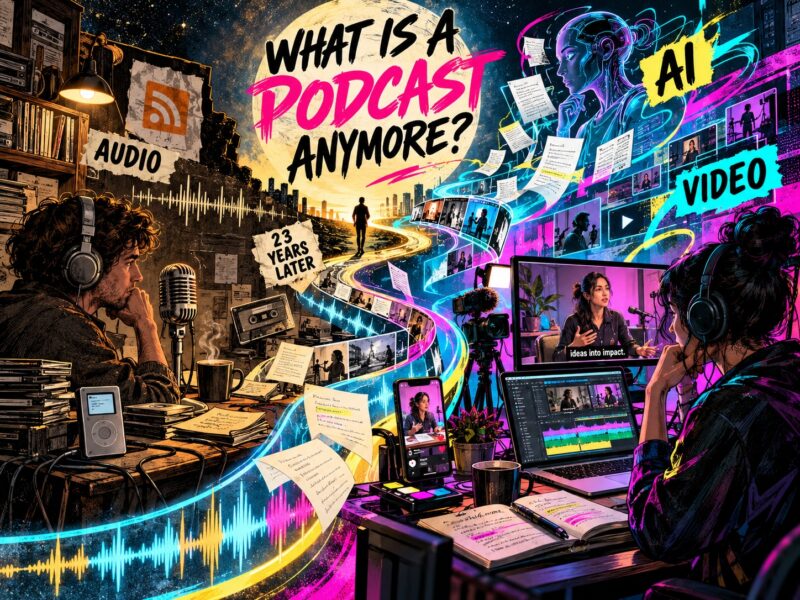
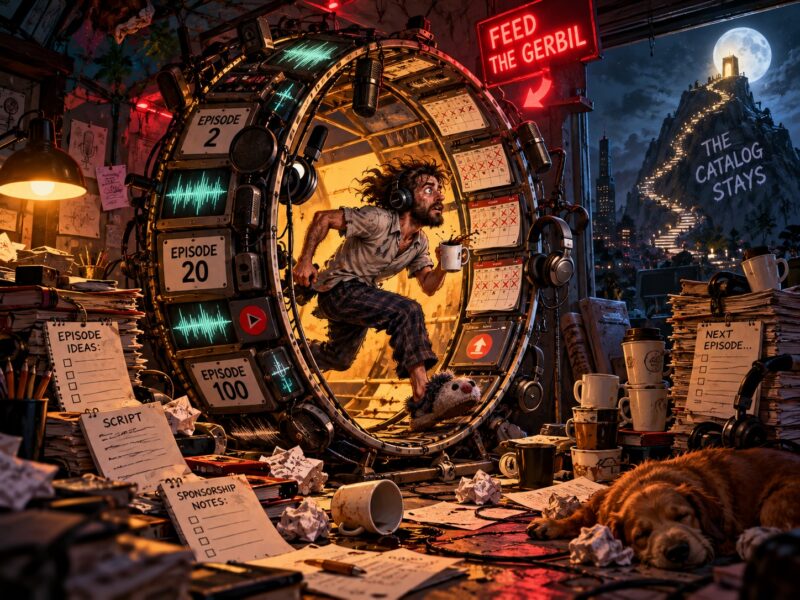
It started as an audio file delivered through RSS. Twenty-three years later, 167 million Americans consume podcasts every month, video is becoming part of the definition, AI can write and narrate the show, and apparently the microphone isn’t even required anymore. Welcome to the gerbil wheel.
🎙️ THIS WHOLE THING IS ONLY ABOUT 23 YEARS OLD.
Podcasting feels like it has been around forever.
It hasn’t.
In July 2003, journalist Christopher Lydon published an interview with software developer Dave Winer using technology that automatically delivered the audio through an RSS feed. Guinness World Records recognizes that as the first podcast, although nobody actually called it a podcast yet. The word itself arrived in 2004 when journalist Ben Hammersley combined iPod and broadcast into something that stuck. Guinness World Records
Then Apple poured gasoline on it.
In June 2005, Apple added podcast support directly into iTunes 4.9. Steve Jobs called podcasting “the next generation of radio,” and Apple launched a directory containing more than 3,000 free shows. Within two days, users had already created more than one million podcast subscriptions through iTunes. Apple
Think about that. Twenty-three years.
That’s it.
Radio had been around for generations. Television had already transformed the world.
Then somebody figured out: What if the radio show waits for YOU instead of you waiting for the radio show?
That was the revolution.
📻 SO WHAT WAS A PODCAST?
Originally, the idea was pretty simple. Somebody recorded audio. That audio was attached to an RSS feed.
You subscribed.
When a new episode appeared, software downloaded it to your computer or MP3 player. You listened whenever you wanted.
- No radio tower.
- No local station manager.
- No requirement to tune in at exactly 7:00 PM.
It was basically radio that escaped the radio station. 😂
And for a long time, when somebody said “podcast,” that was still the mental picture. A microphone. Headphones. Maybe two people sitting across a table talking to each other and an audience like a Saturday Night Live skit. An audio file that showed up on Apple Podcasts, Spotify or another listening app.
Except that isn’t really what a podcast looks like anymore.
📺 WAIT. ARE WE LISTENING TO PODCASTS OR WATCHING THEM?
Apparently both.
Edison Research estimates that in 2026, 58% of Americans age 12 and older consumed a podcast in the previous month—about 167 million people. Weekly consumption reached 45%.
But here’s the number that really jumped out at me:
57% of Americans have both listened to AND watched a podcast. Edison Research
So what exactly are we talking about now?
- An audio show?
- A YouTube show?
- A talk show?
- Internet radio?
- Streaming television?
All of the above? 😂
Even the Interactive Advertising Bureau acknowledged the problem in its 2025 advertising report. It said the traditional audio-based definition of “podcasting” is now rapidly expanding as video becomes a leading channel for podcast consumption. IAB
That makes sense when you look around. Some people still produce traditional audio-only programs. Others sit in a studio with cameras and microphones and distribute basically the same conversation as an audio podcast, YouTube video and short social-media clips.
Some shows barely resemble the old RSS-audio concept at all.
The format didn’t die.
It just swallowed several other formats.
💰 AND THIS ISN’T A LITTLE HOBBY INDUSTRY ANYMORE.
In 2025, U.S. podcast advertising revenue reached approximately $2.86 billion, up 17.6% from the year before. IAB
Read that again.
Almost $3 billion in advertising revenue around something whose name didn’t even exist until 2004.
And that’s advertising.
It doesn’t include every dollar being made through paid subscriptions, Patreon memberships, merchandise, affiliate offers, live events, books, consulting, YouTube monetization or whatever else the creator built around the show.
That is where my Sales Freak brain starts paying attention.
Because now a podcast is no longer merely:
“I have something I want to talk about.”
It can become a media business.
But there’s another side to that story.
🐹 WELCOME TO THE GERBIL ON THE WHEEL.
I’ve listened to podcasts for years.
One of the shows I used to listen to while driving between New Mexico and Colorado was called Nightmare Society.
Six hours in a vehicle goes by considerably faster when somebody is telling you creepy stories about murders, stalkers, strange encounters and things going bump in the night. 😂 Especially when you’re driving through the New Mexico and Colorado mountains at night waiting for a Bigfoot or a Skinwalker to jump in front of your car.
The show is hosted by Kyle, who goes by Creepy Voice Guy, and there is a substantial back catalog of episodes that can still be found through Podbean and other podcast platforms. Podbean currently links the show to Spotify, Amazon Music and Podchaser, and the Apple Podcasts listing remains available too. Nightmare Society
Here’s where it gets interesting. I recently asked Google whether Nightmare Society was still active.
Google essentially told me:
Yep. Kyle is still producing episodes.
Okay.
Then I looked at the actual feed.
The newest public episode I can find is: S24E05: Deadly Silence — October 31, 2024. Nightmare Society
So apparently checking whether a podcast is still podcasting now requires fact-checking the artificial intelligence. 😂
I’m not bringing this up to pick on Kyle. Quite the opposite.
I liked the show. I just gave it a plug here.
You should go listen to it. Some of his episodes would make for a great Parking Spot on Grave Freak.
And his own comments reveal something about podcasting that almost nobody thinks about when they enthusiastically announce:
I’M STARTING A PODCAST!
Wonderful.
What are you doing for Episode 2?
Episode 20?
Episode 100?
In March 2024, one of the Nightmare Society episode descriptions actually acknowledged that keeping the podcast alive was difficult and that he planned to evaluate whether continuing the show was sustainable. Amazon Music
There it is.
The gerbil on the wheel.
🐹 THE AUDIENCE GETS HUNGRY AGAIN NEXT WEEK.
A podcast can create a valuable catalog.
That’s the fantastic part.
I can still find Nightmare Society today. I can still listen to something Kyle created years ago. The work didn’t evaporate because the calendar moved forward.
But the audience for an ongoing show normally expects something else.
- Another episode.
- Another interview.
- Another story.
- Another video.
- Another Tuesday.
Joe Rogan doesn’t create one episode and say:
“Well, that should hold everybody until 2031.” 😂
That doesn’t mean you shouldn’t start a podcast. The numbers we just looked at would make that a ridiculous conclusion.
It means you should understand the business you are volunteering for.
If people like your show enough to subscribe, they usually want more of the thing they subscribed to.
And congratulations.
You have created a really hungry gerbil.
🤖 EXCEPT THE PODCAST STUDIO JUST CHANGED AGAIN.
Twenty years ago, producing a professional-sounding show could require microphones, mixers, audio software, editing knowledge, recording space and somebody who knew what all the buttons did.
You can still build that studio. But now AI has walked into this industry too.
Current podcast-production tools can already help creators research ideas, generate outlines, draft scripts, develop interview questions, transcribe recordings, edit audio through text, remove filler material, generate show notes and create promotional copy.
And yes: AI can even talk.
Descript, for example, currently lets a creator generate a podcast script, record it personally or assign that script to an AI-generated voice or an authorized clone of the creator’s own voice. The platform can also turn a recording into a transcript and let the creator edit the audio by editing the words. Descript
And there are other software programs that can do this as well for a fraction of what you might expect.
Think about what that means for a minute.
🫥 YOU COULD BECOME THE INVISIBLE MAN.
Or Invisible Woman. 😂
- You come up with the idea.
- You decide what the show is about.
- You research the subject.
- You direct the AI.
AI helps develop the script.
You rewrite whatever needs rewriting because AI still has that annoying habit of occasionally deciding to chase an imaginary rabbit, leaving you trying to create a better prompt.
Then you use your own voice. Or an authorized synthetic voice. Or a voice you intentionally created for the program.
- You edit it.
- Add music.
- Build the episode.
Publish it.
Nobody ever has to see you.
They may never even hear your biological voice.
You don’t have to be like Kyle anymore as the Creepy Voice Guy.
That is a pretty dramatic change from the traditional image of the radio host sitting behind a giant microphone.
You essentially became a tiny media company sitting at your computer.
That’s pretty nuts, isn’t it? And if you think there’s something wrong with what I just described, you can certainly do it the old-fashioned way as well.
However, let me clue you in with my Sales Freak brain for a minute. Modern music already relies heavily on digital production—pitch correction, editing, effects, virtual instruments and software that musicians decades ago never had.
Think about how radically technology can change an opportunity. Go back to the 1800s and imagine a woman with an incredible voice singing in a saloon somewhere. If she announced, “Someday I’m going to sing for hundreds of millions of people around the world and become a billionaire doing it,” they probably would have laughed her off the bar stool.
That wasn’t a thing then. That kind of opportunity basically didn’t exist.
It does now. Taylor Swift and Beyoncé live in a completely different world.
Their talent matters, obviously. But so do recorded music, radio, television, global touring, streaming, social media and digital distribution—all technologies that allow one performer to reach an audience a singer in the 1800s couldn’t possibly have imagined.
Technology changed the audience, and that changed the opportunity.
And I think AI is about to do something similar for people who want to create media.
The tools changed. The human creator didn’t disappear.
✍️ BUT SOMEBODY STILL HAS TO KNOW WHAT THE SHOW IS.
This is the same thing I keep discovering every time I use AI.
The machine can help produce.
- It can draft.
- It can edit.
- It can speak.
- It can create graphics.
- It can summarize.
But somebody still needs an idea worth turning into an episode. Somebody has to decide what the story is, what belongs in it, what doesn’t belong in it and why somebody should spend thirty minutes listening.
That’s where writing keeps sneaking back into the room.
Before the microphone turns on, somebody usually has to think about:
- The topic and angle.
- The opening hook.
- Research and facts.
- Interview questions or narration.
- Episode title and description.
- Sponsor or affiliate message.
- Call to action.
So maybe podcasting never stopped being writing.
It just learned how to talk. 😂
Which is why I included podcasts on Writers Freak.
💵 OKAY. SO HOW DOES A PODCAST MAKE MONEY?
Here’s where people sometimes make the same mistake they make with YouTube.
They think: I’ll upload the thing and the platform will pay me.
Maybe. Eventually. Under the right conditions.
Spotify currently offers several monetization routes, including its Partner Program, subscriptions, sponsorship tools and outside subscription integration. Eligibility varies by program; for example, the current U.S. Partner Program requires at least three published episodes, 2,000 global consumption hours and 1,000 unique Spotify listeners or viewers during the previous 30 days. Spotify
Under the Partner Program, Spotify says eligible creators can receive advertising revenue and revenue tied to qualifying Premium video consumption. Spotify currently pays creators a 50% share of recognized ad revenue for qualifying Partner Program ads. Spotify
Apple works differently.
Apple Podcasts allows creators to sell paid subscriptions. Apple currently says creators receive 70% of subscription revenue during a subscriber’s first year and 85% after that subscriber accumulates one year of paid service, minus applicable taxes. Apple says the creator keeps other podcast revenue, including advertising revenue. Apple Podcasts
So which one pays better?
Wrong question.
💰 WHY ARE YOU EXPECTING ONE PLATFORM TO BE YOUR ENTIRE BUSINESS?
That’s the question I would ask.
- Maybe Spotify makes sense for your show.
- Maybe Apple subscriptions make sense.
- Maybe YouTube or Rumble is where the video audience lives and, if you qualify for monetization, where those views can generate revenue.
- Maybe Patreon works and people can financially support your podcast.
- Maybe you have your own membership program.
- Maybe a company sponsors the show.
- Maybe you’re an affiliate for something you genuinely use or believe could help fund your show.
- Maybe the podcast exists primarily to sell your own product or service.
- Maybe several of those things work together.
Why should the entire business depend on whether one giant technology company decides your show qualifies for its monetization program?
Spotify is a distribution platform.
Apple Podcasts is a distribution platform.
YouTube is a distribution platform.
Rumble is a distribution platform.
They are what I would call important roads.
You still need somewhere to send the traffic.
🚗 JOE ROGAN WASN’T DISCOVERED BY SPOTIFY.
This distinction gets lost all the time.
Joe Rogan didn’t upload Episode 1 to Spotify and wait for somebody at corporate headquarters to discover him. He spent years building The Joe Rogan Experience and an enormous audience before Spotify entered into its major relationship with him.
That’s very different. The platform did not magically create the original audience from nothing.
So if you start a podcast tomorrow and put it on Spotify, Apple Podcasts and YouTube, congratulations.
Your podcast exists.
That isn’t the same thing as: People know your podcast exists.
Welcome to the “Wonderful World of Media.” 😂
🅿️ THIS IS WHERE I WOULD GET OFF THE GERBIL WHEEL FOR FIVE MINUTES.
This is where Writers Freak fits differently from the podcast itself.
A podcast feed needs episodes. A Writers Freak Parking Spot doesn’t.
I can create this page, publish it and walk away if I want to. It remains a page I control.
- Maybe people find it through search.
- Maybe I send people to it from X.
- Maybe somebody shares it.
- Maybe nobody looks at it tomorrow.
It isn’t standing there tapping its foot asking me where Episode 47 is. 😂
And if I owned a podcast, I could use a Parking Spot as something completely different from the feed.
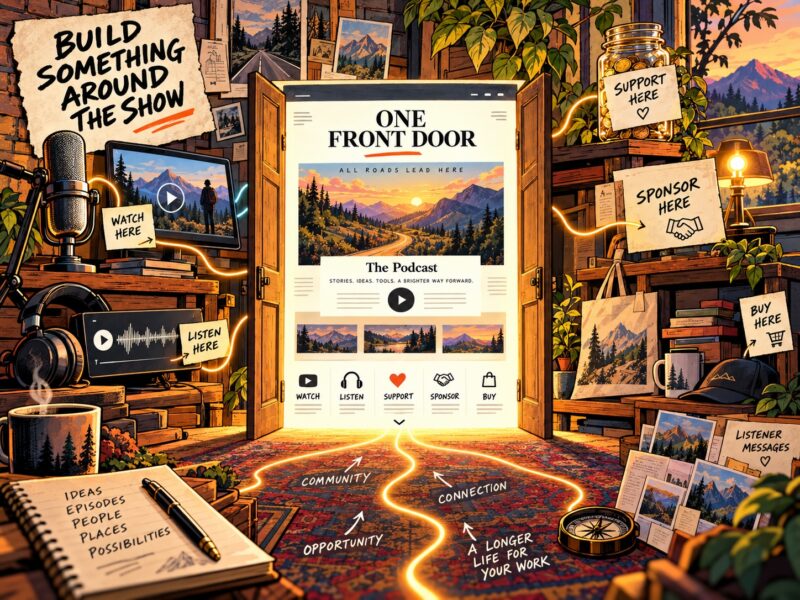
- A written front door.
- Tell people what the show is.
- Explain who it’s for.
- Embed a supported YouTube or Rumble video.
- Point them toward Spotify.
- Link the Apple Podcasts subscription.
- Send them to Patreon.
- Show photographs.
- Explain how the show started.
Feature the episode I think somebody should hear first.
And if I’m selling something?
Put the link there.
🎯 WHAT DO YOU ACTUALLY WANT THE LISTENER TO DO?
This question is bigger than podcasting.
You worked hard to get somebody’s attention.
Now what?
Maybe you want them to:
- Listen to another episode.
- Subscribe to the show.
- Watch the video version.
- Join your paid membership.
- Buy your book or product.
- Use an affiliate link you disclosed.
- Contact you about advertising.
- Sponsor the podcast.
- Visit your website.
- Follow you somewhere else.
Those are completely different goals.
If somebody just finished listening to you for an hour, that person has given you something incredibly valuable:
Their attention.
Don’t waste it.
🤝 AND WHAT IF YOU NEED A SPONSOR?
Now we’ve wandered onto another Freak Site. 😂
Suppose you have a podcast with a real audience but you need somebody willing to sponsor the thing.
That sounds like a Sponsors Freak conversation.
You could build a Writers Freak Parking Spot explaining the show, then use Sponsors Freak to start talking about the sponsorship side of the business.
Or maybe you’re the podcaster who becomes an affiliate and introduces other creators to Writers Freak.
Or Sponsors Freak.
Now instead of thinking:
“I have a podcast.”
you start thinking:
“I have a media asset. What can I build around it?”
That’s a completely different mindset.
🎧 AND HERE’S WHAT I LIKE ABOUT NIGHTMARE SOCIETY.
The public feed may not have a new episode since October 31, 2024—which was very fitting for Halloween night for that program.
But the old episodes still exist. I can still remember listening to them while driving across the Southwest.
That means Kyle created something with a shelf life beyond the day he published it.
That matters.
There’s no reason every creative project needs to run forever.
- Maybe a podcast lasts ten episodes.
- Maybe fifty.
- Maybe five hundred.
Maybe you finish telling the story you wanted to tell and you’re done.
Maybe you decide it is too much effort for the reward. You intended it as a side business and the profit margin turned it into a hobby.
Nothing wrong with that.
The mistake would be thinking the audience owes you an audience merely because you uploaded the files.
They don’t.
The other mistake is thinking that you owe the audience anything beyond what you’ve provided if you decide it’s time to move on.
You don’t.
🐹 THE GERBIL IS OPTIONAL.
This is probably the strangest lesson in the whole thing.
Podcasting has never been easier to start. The audience has never been larger.
Video has expanded what we even mean by “podcast.” AI can help somebody write, edit, narrate and produce a show without the kind of studio once required.
There are billions of advertising dollars in the industry, and you can build revenue around subscriptions, advertising, sponsors, affiliates, products and memberships.
That is extraordinary.
But before you run out and buy a microphone, ask yourself one question:
DO I WANT TO KEEP FEEDING THIS THING? 😂
If the answer is yes?
Great. Feed it. Build the audience. Build the catalog.
See where it goes.
But also build things around the podcast that don’t disappear into the feed every time you upload the next episode.
That might be your website.
- Your email list.
- Your membership.
- Your social accounts.
- Your sponsors.
- Your products.
And yes…
maybe a $7 Parking Spot on Writers Freak.
🅿️ GIVE THE SHOW A FRONT DOOR.
A standard Writers Freak Parking Spot is $7 one time.
You can tell the story behind your podcast, add photographs, embed supported video, link to your show and your other platforms, promote something you sell and update the page later if the show changes.
No monthly fee.
No scheduled renewal.
No scheduled expiration.
Seven bucks.
The podcast started as audio traveling through an RSS feed.
Twenty-three years later we’re watching it, monetizing it, feeding it to AI, giving AI a voice and building businesses around it.
Apparently the pod part survived even after the iPod mostly disappeared.
😂
The technology changed. The platforms changed. The studio changed.
But one question hasn’t:
DO YOU HAVE SOMETHING PEOPLE WANT TO HEAR?
And if you do…
Give them somewhere else to find you when the episode ends.